
Baccarat Rules
In baccarat you bet on which of two hands, Player or Banker, ends closer to 9, or on a tie. You make no choices after the bet: the dealer follows fixed rules for when each hand takes a third card. The Banker bet is the best of the three, with a house edge of 1.06% after its 5% commission. The Tie bet costs 14.36% at 8 to 1.
| Bet | Pays | Wins | House edge |
|---|---|---|---|
| Banker | 19 to 20 (even money less 5% commission) | 45.86% | 1.06% |
| Player | 1 to 1 | 44.62% | 1.24% |
| Tie | 8 to 1 | 9.52% | 14.36% |
How a round works
- Bet on Player, Banker or Tie.
- The dealer deals two cards to each hand.
- Count each hand: aces count 1, 2s through 9s count their face value, and 10s and face cards count 0. Only the last digit counts, so 7 + 8 = 15 is a 5.
- If either hand has 8 or 9 (a “natural”), both hands stand and the round is over.
- Otherwise the Player hand takes a third card on 0 to 5 and stands on 6 or 7.
- The Banker hand then draws or stands by the table below.
- The hand closer to 9 wins. Equal totals are a tie.
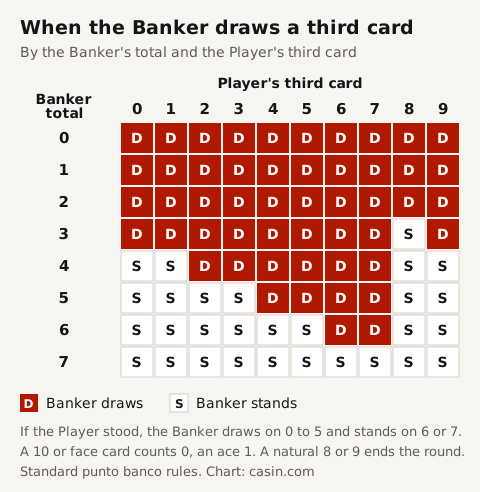
When the Banker draws a third card
If the Player hand stood, the Banker draws on 0 to 5 and stands on 6 or 7. If the Player took a third card, the Banker's choice depends on that card:
| Banker total | Banker draws when the Player's third card is |
|---|---|
| 0, 1, 2 | any card |
| 3 | anything but an 8 |
| 4 | 2 to 7 |
| 5 | 4 to 7 |
| 6 | 6 or 7 |
| 7 | never (stands) |
A hand, step by step
The Player hand gets a 3 and a 2: 5, so it draws. The third card is a 9, and 5 + 9 = 14 counts as 4. The Banker hand has a king and a 5: 5. With 5, the Banker draws only if the Player's third card was 4 to 7, so it stands. Banker 5 beats Player 4. A $10 Banker bet wins $9.50.
The odds of each bet
The Banker hand wins a little more often, 45.86% of rounds against 44.62%, because it draws knowing the Player's third card. The 5% commission more than cancels that, so on $100 of bets the Banker costs you $1.06 on average and the Player $1.24.
The Tie wins 9.52% of rounds. At 8 to 1 it costs $14.36 per $100; some tables pay 9 to 1, which cuts that to $4.84. Some “no commission” tables pay the Banker even money but only half when it wins with 6; that raises the Banker's house edge to 1.46%. EZ Baccarat, dealt in many US casinos, pays even money but makes a Banker win with three cards totaling 7 a push; that lowers the Banker's edge to 1.02%.
Mistakes that cost money
- Betting the Tie for the 8 to 1. Fair odds for a bet that wins 9.52% of the time would be about 9.5 to 1.
- Following the scorecard. No pattern in past hands changes the house edge of the next one.
- Picking a no-commission table that pays half on a Banker 6. That rule costs more than the commission: 1.46% against 1.06%. EZ Baccarat's push on a three-card 7 is the cheaper trade, at 1.02%.
Questions
Is it better to bet on Banker or Player?
Banker: its house edge is 1.06% against 1.24% for Player.
Why does the Banker bet pay a commission?
Because it wins more often. Paid at even money, it would give you an edge of 1.24%.
What is a natural in baccarat?
A two-card total of 8 or 9. Both hands stand, and the higher total wins.
Can a hand have more than three cards?
No. Each hand gets two cards and at most one more.
Does the number of decks matter?
Very little. With six decks the Banker's house edge is 1.06% and the Player's 1.24%, the same to two decimals.
More table games: Casino War · Let It Ride · blackjack rules · live casino.
How we checked. By the casin.com team. Last checked November 6, 2026. We worked out the odds with our own program, which counts every possible deal from an eight-deck shoe. The results match the published figures of the Wizard of Odds (wizardofodds.com). The drawing rules are the standard punto banco rules.


