


Dutch Gambling Market 2025: Online Revenue Falls 21%, KSA Says
Published: October 31, 2026 | Author: Roxy Vance
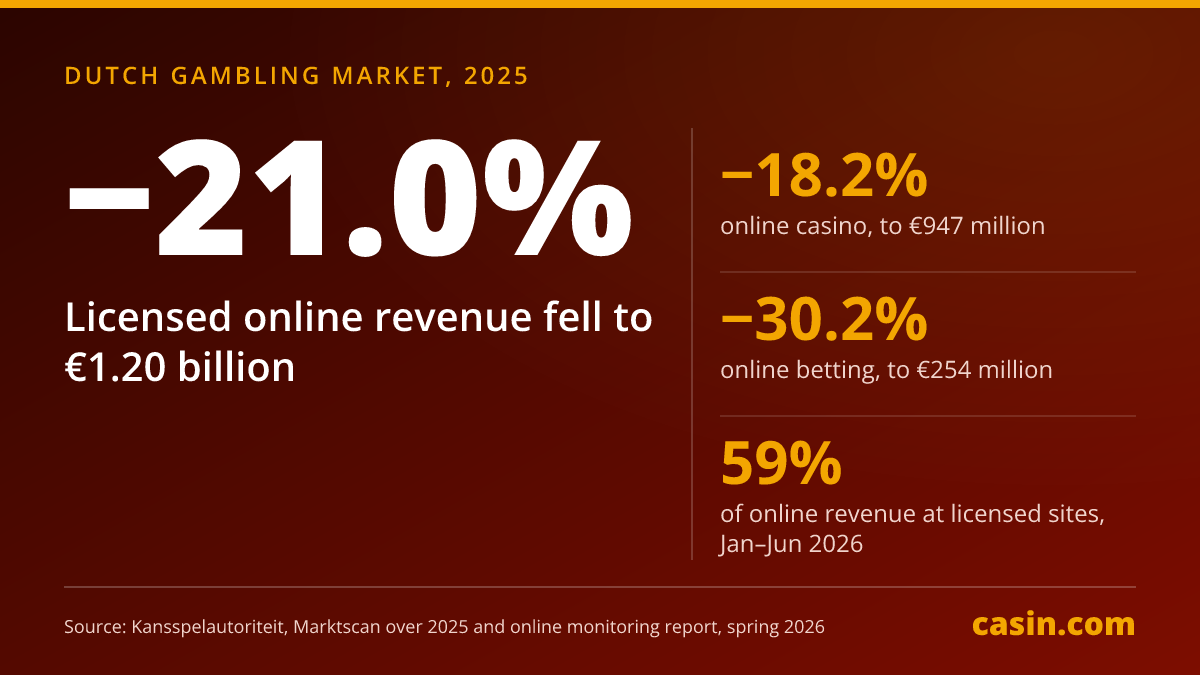
The licensed online gambling market in the Netherlands shrank by 21% in 2025, as gross gaming revenue fell to €1.20 billion from €1.52 billion, according to the Netherlands Gambling Authority (Kansspelautoriteit, KSA). The figures, published on October 29, 2026, cover the first full year of the online deposit limits introduced in October 2024, and the whole licensed market, online and land-based, took in €4.1 billion, down from €4.5 billion in 2024 after adjusting for inflation.
The numbers come from the KSA’s yearly market scan, released together with its half-year report on online gambling for January to June 2026. The market scan covers licensed operators only and measures the gross gaming result (BSR): stakes minus prizes paid out. The market scan’s 2024 comparisons are adjusted for inflation.
Online Casino and Betting Fell Most
Online casino revenue fell 18.2% to €947 million, €210 million less than in 2024. Online betting fell further, by 30.2% to €254 million. Land-based casino games and gaming machines were almost flat, down 1.0% to €1.33 billion. The table shows the main segments.
| Segment | 2025 | 2024 (inflation-adjusted) |
|---|---|---|
| Online casino | €947 million | €1.16 billion |
| Online betting | €254 million | €364 million |
| Holland Casino | €683 million | €664 million |
| Gaming machines in arcades | €539 million | €562 million |
| Gaming machines in hospitality venues | €104 million | €113 million |
| Total licensed market | €4.1 billion | €4.5 billion |
Revenue at Holland Casino, the state-owned company that holds the monopoly casino license, rose 2.8%, and the KSA notes that it depends more and more on its gaming machines. Revenue from machines in arcades and hospitality venues fell 4.7% together. Lottery revenue fell 1.8%, while land-based betting rose 8.5%, which the KSA said may reflect lighter rules offline, such as less strict duty-of-care rules and no checks against the national self-exclusion register, Cruks.
Why the Market Shrank
The KSA said the online decline is probably at least partly due to three things: the duty-of-care rules that took effect on October 1, 2024, the higher gambling tax, and a drop-off after the men’s European Championship in 2024. The main change in the 2024 rules was a net deposit limit of €300 a month for players aged 18 to 23 and €700 a month for those aged 24 and over, which a player can raise only by showing they can afford it.
Gambling tax rose from 30.5% to 34.2% during 2025 and to 37.8% from January 1, 2026. Euro 2024 had probably lifted betting and casino revenue in summer 2024, and 2025 had no comparable event. Since July 1, 2025, online operators have also been barred from sponsoring sports clubs, matches and athletes, the latest in a series of advertising and sponsorship restrictions that began in July 2023.
The average Dutch adult lost €282 on licensed gambling in 2025, down from €307 in 2024. The EU average, measured in Dutch income and purchasing power, was €369.
Early 2026: Revenue Up, More Accounts
Licensed online operators took in €670 million from January to June 2026, about 11% more than the €602 million of the second half of 2025, and the KSA said the men’s World Cup may explain the rise. Casino games played against the house made up 73% of that revenue and sports betting 24%.
Players used an average of 1.48 million accounts a month, up from 1.38 million. The number of people gambling does not seem to have risen: the KSA estimates about 820,000 people played with a licensed operator at least once in the half-year, against 830,000 before, and about 490,000 in an average month, against 510,000. The KSA said this may mean some players are using more accounts to get around the per-account deposit limits.
The average loss per account was €75 a month, and €34 for players aged 18 to 23. Per player, the KSA estimates an average loss of €137 a month, up from €121 in the second half of 2025 but below the €160 of early 2024, before the new rules.
How Much Play Stays With Licensed Sites
The KSA estimates that 94% to 97% of people who gamble online do so with licensed operators, depending on how it counts people who use both licensed and unlicensed sites. Measured by revenue, the licensed share is lower but rising: 59% in the first half of 2026, up from 54% in the second half of 2025. The gap between the two measures suggests that people who gamble at unlicensed sites lose considerably more on average, according to the KSA, whose figures on the illegal market are estimates from a panel of about 6,000 people and from search data.
The KSA found no sign that stricter rules have pushed players to unlicensed sites. Treatment numbers rose, however: 3,108 people were treated for gambling addiction in 2025, more than 14% more than in 2024. On July 31, 2026, 120,200 people were registered in Cruks.
What It Means
The licensed Dutch market shrank in the first full year of the deposit limits and the higher tax, while the share of revenue staying with licensed operators improved. The KSA points out that these protections cover only people who play with licensed operators, which must check Cruks before letting anyone play. Its Kansspelwijzer lists the operators that hold a license to offer online gambling in the Netherlands.

