Published: November 13, 2026 | Author: Roxy Vance
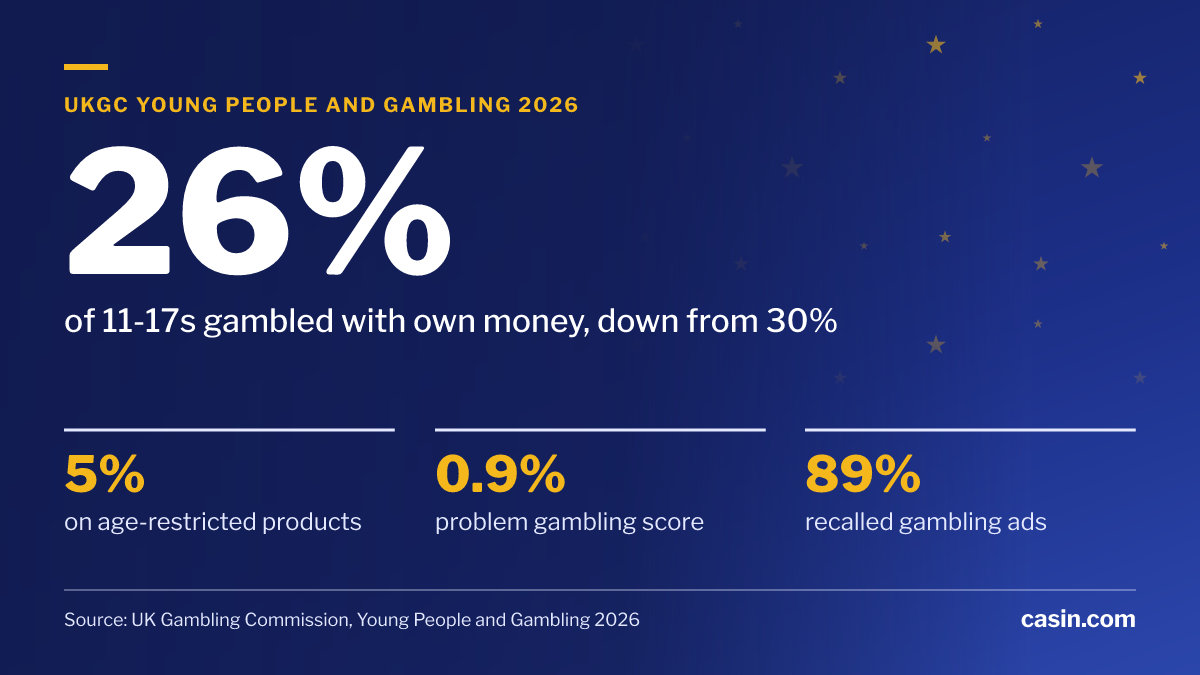
About one in four 11 to 17 year olds in Great Britain, 26%, gambled with their own money in the 12 months before they were surveyed, down from 30% in 2025, according to official statistics the UK Gambling Commission (UKGC) published on November 12, 2026. Most of that gambling was on activities with no age limit, such as arcade machines and bets with family or friends, while 5% spent their own money on age-restricted gambling products.
The Young People and Gambling 2026 report, produced by Ipsos, is based on a survey of 3,867 pupils aged 11 to 17 at schools in England, Scotland and Wales, carried out between January 12 and June 12, 2026.
What the Survey Found
| Share of 11-17 year olds | 2026 | 2025 | Significant change? |
|---|---|---|---|
| Gambled with own money, past 12 months | 26% | 30% | yes, down |
| Any gambling, past 12 months | 45% | 49% | yes, down |
| Gambled with own money, past 4 weeks | 12% | 16% | yes, down |
| Gambled with own money, past 7 days | 5% | 6% | no |
| Problem gambling score (4+) | 0.9% | 1.2% | no |
| At-risk score (2-3) | 2.0% | 2.2% | no |
In 2022, 31% had gambled with their own money in the past year and 50% had gambled in any form. “Own money” means pocket money, birthday money or money young people earned or got as a reward. Counting activities where they did not spend their own money, 45% had gambled in the past year.
The most common activities paid for with their own money were arcade gaming machines such as penny pushers and claw grabbers (19%), bets with friends or family (11%) and cards for money (5%). Online gambling was rare: 1% used a betting website or app with their own money, and 1% played a game on a casino website.
Some 0.9% scored 4 or more on the DSM-IV-MR-J screen, which the UKGC describes as experiencing negative consequences from gambling, against 1.2% in 2025, a change the regulator says is not statistically significant. The UKGC stresses that the screen is not a clinical diagnosis and that using the data to measure addiction “would be a misuse of our data.”
Boys (26%) and girls (25%) were about equally likely to have gambled with their own money, but 14 to 17 year olds were more likely to than 11 to 13 year olds, at 29% against 22%.
Advertising and Loot Boxes
Almost nine in 10 young people, 89%, recalled seeing or hearing gambling advertising or promotions in the past year, including 69% on TV, 68% in apps and 61% on social media. The report also found that 22% had opened virtual loot boxes or surprise boxes using their own money.
What It Means for Parents
Most of the gambling young people paid for themselves was on activities without an age limit, such as arcade machines and bets within the family, the figures show. For age-restricted products, the UKGC requires operators to have robust protections that stop children betting in bookmakers or playing at online casinos. In the survey, 17% said they had been stopped from gambling because they were too young, up from 13% in 2025.
The Commission’s focus is on ensuring that children and young people are not able to spend money on age-restricted gambling products, with an appreciation of the wider context.
Ben Haden, Director of Research and Statistics, UK Gambling Commission
What Happens Next
The UKGC says it uses the survey to guide regulatory action when appropriate and to inform its wider thinking on protecting children and vulnerable young people. Haden called it “an important survey that provides one perspective” as the regulator seeks “to protect children and vulnerable young people.”
The figures are self-reported estimates and do not cover young people outside mainstream education, the regulator notes. The statistics follow the UKGC’s November 5 estimates of consumers’ use of illegal gambling sites, and its November 9 statement that it will increasingly “follow the money” in its work against illegal gambling.