
UKGC Steps Up Illegal-Site Takedowns, Readies Financial Risk Checks
Published: November 7, 2026 | Author: Roxy Vance
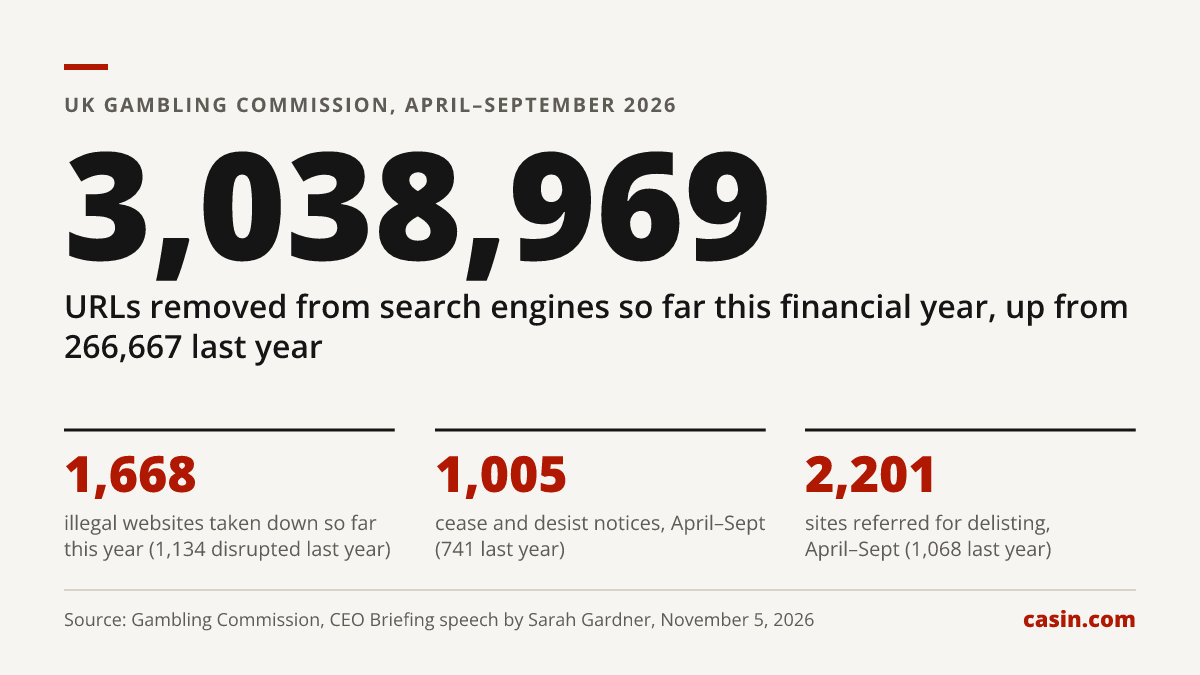
The UK Gambling Commission (UKGC) has had more than 3 million URLs removed from search engines so far this financial year as it steps up action against illegal gambling firms targeting Great Britain, and has already taken down more websites than it disrupted in the whole of last year. Acting chief executive Sarah Gardner gave the figures at the regulator’s CEO Briefing on November 5, 2026, and said its consultation response on financial risk checks for high-spending customers is due within weeks.
What the Regulator Reported
Gardner compared last financial year with the first six months of the current one, in a speech the UKGC published on November 6. The UKGC issued 1,005 cease and desist notices to advertisers and operators from April to September 2026, against 741 in the whole of last financial year.
Last financial year the UKGC reported 397,527 URLs to search engines and 266,667 were removed; so far this financial year it has reported 7,824,932, and 3,038,969 have been removed. It referred 2,201 websites to search engines for delisting from April to September, up from 1,068 last year. Last year 1,134 websites were disrupted, meaning taken down or geo-blocked, and 1,668 have been taken down so far this year.
“There is more to do. These numbers only paint a picture of some of the activity we’re doing and some of what we need to do,” Gardner said.
The rise comes a year after last year’s Budget, where the government committed £26 million over three years to help the UKGC tackle the illegal market. The first £7 million arrived just over six months before the speech, and Gardner said it has let the regulator start to scale up. A minister-led taskforce on the illegal market has also been set up.
UKGC research published the same morning found that, in the year to April 2026, 4% of people who gamble online, excluding the National Lottery, had engaged with illegal gambling websites in the previous 12 months. We covered those survey findings on November 5.
Financial Risk Checks Are Next
The UKGC announced on July 7, 2026 that it will introduce Financial Risk Assessments (FRAs) in stages, to identify high-spending customers in financial difficulty. On November 5, Gardner said the regulator is “finalising the consultation response for publication in the coming weeks” and remains committed to staged implementation.
The checks are document-free, run by credit reference agencies and have no effect on a customer’s credit score. In stage one, the largest operators will run them when a customer’s net deposits pass £5,000 in a rolling 24 hours, or £2,500 for under-25s and other high-risk groups. Fewer than 0.5% of customers exceed the £5,000 level. Once fully in place, the trigger for customers aged 25 or older will be net deposits above £1,000 in 24 hours or £3,000 in 90 days, and £750 or £2,000 for under-25s.
In the pilot, 97% of customers spending above the thresholds could be assessed without friction, against 80% estimated in the 2023 White Paper. High spenders were two to four times more likely to have a debt management plan, and two to five times more likely to have a default in the previous 12 months, than the wider population.
What It Means for Players
Most players will never be checked: the UKGC says people who bet occasionally, have recently won or regularly spend hundreds of pounds are unlikely to need an assessment. The checks are meant to cut the document requests that some operators use and that many customers dislike. Our guide to legal online gambling in Europe explains how licensing works across the region.
What Happens Next
The FRA consultation response is due in the coming weeks, and an updated UKGC business plan will follow shortly. A new five-year corporate strategy is due in 2027, and Gardner said work on illegal gambling is likely to be “at the forefront” of its crime priority. The first report from NatCen’s independent evaluation of the Gambling Act Review is expected early in the New Year.


