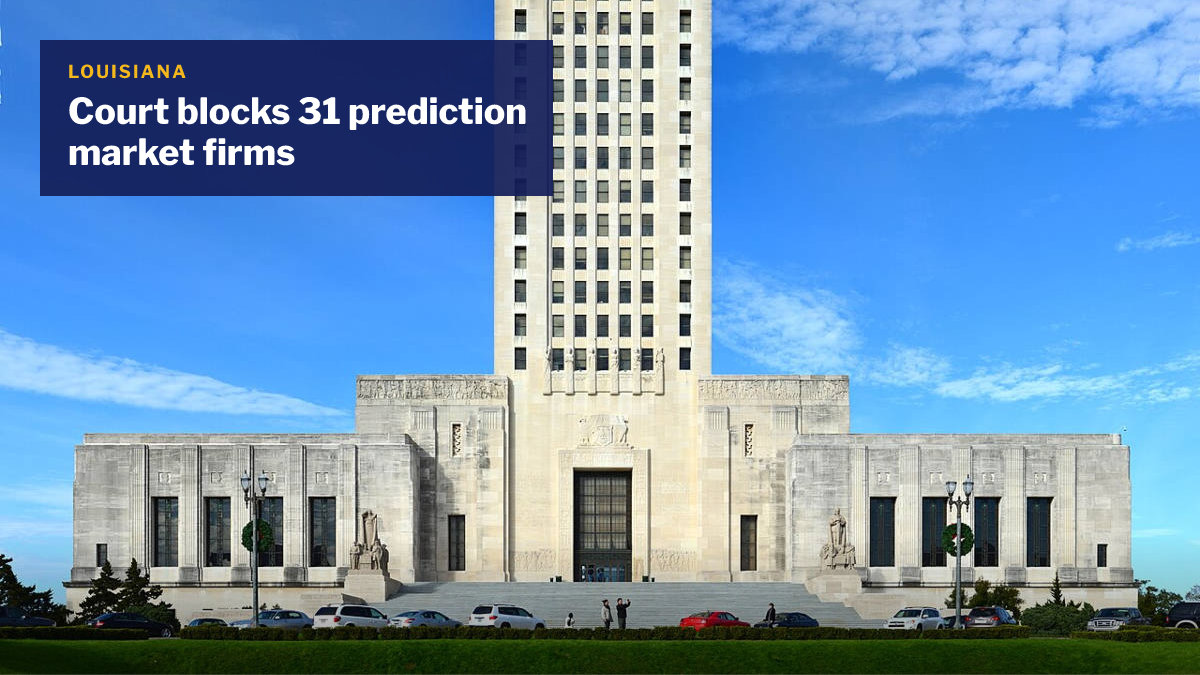
A Louisiana state judge on November 12, 2026, ordered 31 companies, including Kalshi, Polymarket, Robinhood and Coinbase, to stop offering event contracts to anyone in Louisiana without a state gaming license, hours after Attorney General Liz Murrill sued them. It is the latest clash between the states and the federal Commodity Futures Trading Commission (CFTC), which said a day later that it had sued Arkansas, the 11th state it has taken to court, to stop it from shutting down event-contract trading on the prediction markets it regulates.
- Companies named
- 31
- Louisiana order
- Order expires
- Nov 22
- unless extended
- Hearing
- Nov 30
- preliminary injunction
- CFTC state suits
- 11
- Arkansas the latest
What the Louisiana Order Says
Murrill filed the suit in the 21st Judicial District Court in Tangipahoa Parish on the morning of November 12, seeking an immediate restraining order and an injunction, she said on X. District Judge Jeffrey Johnson signed an ex parte temporary restraining order at 3:48 p.m. the same day, without hearing from the companies, and Murrill posted the order.
The order bars the companies from offering, listing, clearing or otherwise facilitating any “event contract,” which it also calls a wager, for people located in Louisiana without a license and permit under the state’s gaming laws. It covers contracts on sports, elections and awards events, and lists bet types from single-game and parlay bets to in-play and proposition bets. The companies must also geofence the state and may not tell anyone in Louisiana that their products are lawful, licensed or authorized there.
Some brands appear through several companies: the 31 defendants include five Kalshi entities and five Polymarket entities, along with companies behind Robinhood, Crypto.com, Coinbase, Gemini, Underdog, Novig, ForecastEx and ProphetX. Johnson wrote that the petition makes clear the companies are currently violating Louisiana’s law against gambling by computer, among other laws.
It’s not complicated: if you aren’t a licensed gaming operator, you aren’t legal. Illegal gambling is a crime and is subject to jail time and significant penalties.
Liz Murrill, Louisiana Attorney General
Kalshi had already sued Murrill, the governor and the Louisiana Gaming Control Board in federal court on October 23, arguing that the CFTC has “exclusive jurisdiction” over event contracts on federally designated exchanges.
The CFTC’s Case Against Arkansas
The complaint, filed by the United States and the CFTC in the federal court for the Eastern District of Arkansas on November 12, names the state and Attorney General Tim Griffin as defendants. It follows Griffin’s November 4 lawsuit against Kalshi in an Arkansas state court under the state’s Deceptive Trade Practices Act, which we covered at the time.
The CFTC asks the court to declare Arkansas law preempted as applied to trades on CFTC-regulated exchanges, and to bar the state from investigating or pursuing those exchanges and their partners. The complaint says the penalties Arkansas could seek, up to $10,000 per violation, could reach hundreds of millions of dollars.
“The CFTC will continue to defend its sole jurisdiction over these federally regulated markets,” Chairman Michael S. Selig said in the release. The complaint lists the 10 states the CFTC had sued before Arkansas, including Utah, New York and Illinois; Louisiana is not among them.
What It Means for Players
While the order is in force, the 31 named companies may not accept event contracts or wagers from people located in Louisiana, and must block access from the state. The order covers the named companies and anyone acting with them who knows of it.
That geofencing is the kind of blocking the CFTC told exchanges to stop on November 5, or explain why they can’t, when it said they generally may not limit access by a user’s location within the US. That guidance does not mention court orders or state gambling laws.
What Happens Next
The Louisiana order expires at 3:48 p.m. on November 22 unless the judge extends it or the companies agree to a longer period. A hearing on Louisiana’s request for a preliminary injunction is set for 9 a.m. on November 30. Exchanges have until December 5 to stop blocking users by state, or explain to the CFTC why they can’t.